
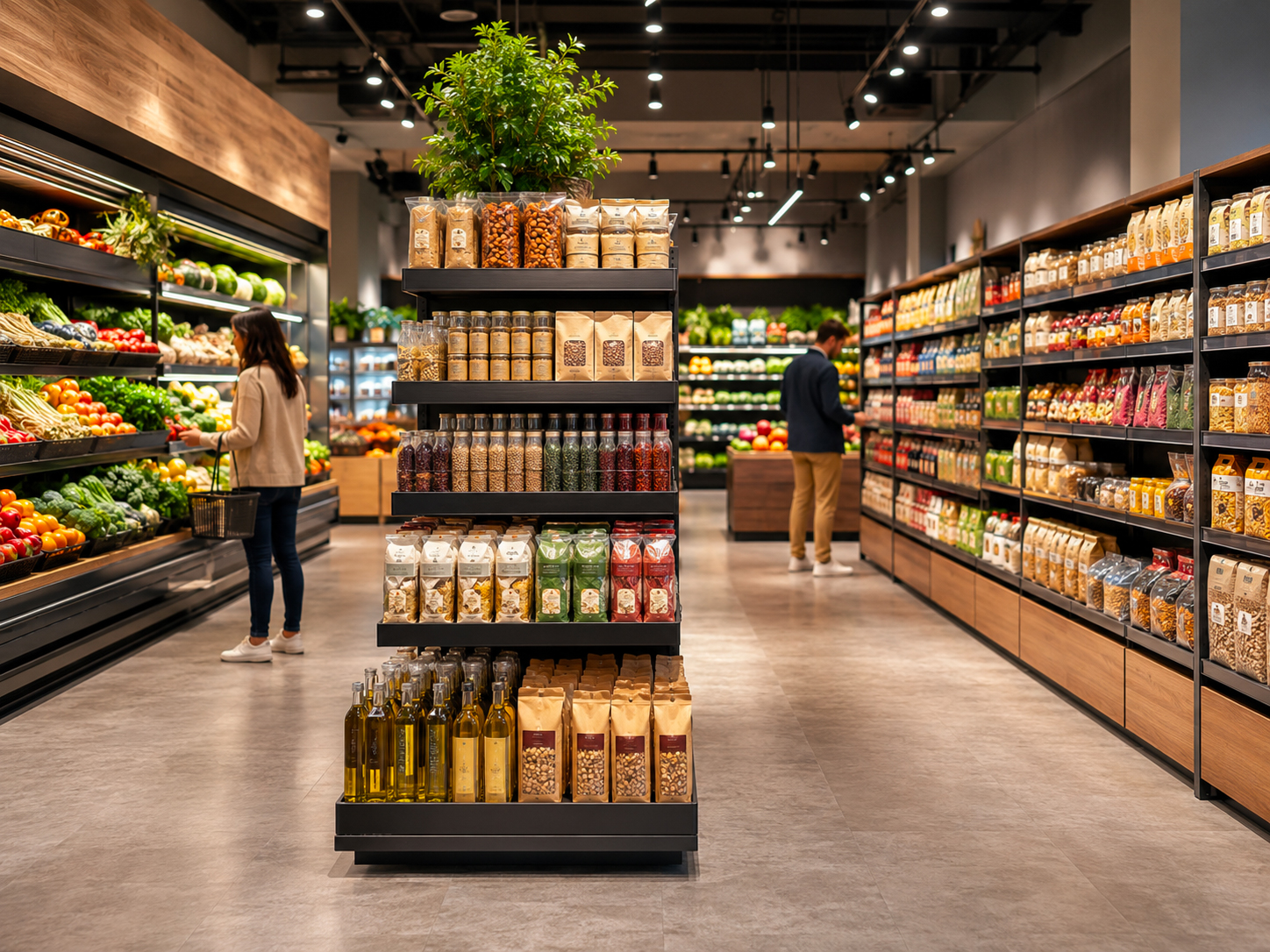
In the food retail sector, the decisive moment isn’t just when a product enters a retailer’s assortment. The real competition continues inside the store, in front of the shelf, where dozens of products compete for the consumer’s attention at the same time.
Being present, in fact, doesn’t necessarily mean being visible. And having a competitive product in terms of quality, price, or positioning doesn’t automatically guarantee good rotation.
This is precisely where visual merchandising comes into play in food distribution, a discipline that uses product arrangement, spatial organization, visual communication, displays, and purchasing paths to facilitate customer selection and improve sales performance.
In the Food & Beverage industry, visual merchandising takes on particular importance because consumers make a significant portion of their decisions directly at the point of sale. Display therefore becomes a tool through which retailers and manufacturers can increase the clarity of categories, highlight specific products, and encourage additional purchases.
But effective visual merchandising isn’t simply about creating prettier shelves. It’s a marketing lever that must be designed based on consumer behavior, category objectives, and the profitability of available space.
The point of sale is a communication tool
A supermarket, a specialized shop or a gourmet outlet communicate continuously with the customer, even when they do not use explicit advertising messages.
The location of departments, the order of categories, the height at which a product is placed, the number of items on display, the presence of promotional displays, and even the spaces left between items all contribute to the perception of the offering.
The consumer must be able to quickly understand what is in front of him.
A shelf that is too crowded, poorly organized or characterized by an unclear visual hierarchy can make the choice more difficult. On the contrary, a correctly designed display can guide the customer towards the product best suited to their needs, facilitating the purchase.
The point of sale therefore becomes a real physical medium, in which every space has an economic and communicative value.
For this reason, visual merchandising and commercial strategy should not be considered two separate areas.
From visibility to product rotation
For a food manufacturer, obtaining a favorable position within the store can have a significant impact on the product’s ability to generate sales.
Two products with similar features and prices can achieve very different results simply because one of the two is more easily identified by the customer.
Visibility is therefore the first step.
But the ultimate goal remains rotation.
Effective display must convert attention into purchase. To achieve this, numerous factors must be considered simultaneously: packaging recognizability, shelf position, amount of frontage, relationship with competing products, presence of promotions, and consistency with the category.
Visual merchandising must therefore answer a very concrete question: how much commercial value can each occupied space generate?
This approach allows us to move beyond a purely aesthetic conception of the exhibition and connect it directly to the performances.
The importance of shelf position
Within the large-scale retail trade, not all positions have the same value.
Areas that are closest to the consumer’s field of vision naturally tend to receive more attention than areas that are harder to reach or observe.
But the ideal position cannot be established through a rule that is valid for any product.
A leading brand, a premium product, a children’s product, an impulse purchase, or a private label all have different needs.
The way in which consumers search for products also varies from category to category.
In some cases, customers already know the brand and product type and quickly search for a recognizable item. In others, they explore the assortment by comparing prices, formats, ingredients, or features.
Understanding these behaviors allows you to design a shelf that simplifies the decision.
Visual merchandising and Category Management
Visual merchandising reaches its maximum effectiveness when inserted within a Category Management strategy.
The category should not be interpreted simply as a space to be filled with as many references as possible.
It must be considered as a set of products that respond to specific consumer needs.
Correctly organizing the category therefore means understanding how the customer thinks, which characteristics he uses to distinguish the products and according to which logic he proceeds during the choice.
Let’s think, for example, of the wine department.
The organization could follow the color, the denomination, the region of origin, the price range, the grape variety or the consumption occasions.
There isn’t necessarily a universally correct solution. The structure should depend on the brand’s positioning, customer profile, and business objectives.
The same principle can be applied to numerous food categories: oils, preserves, cheeses, organic products, plant-based alternatives, beers, snacks, health products, or local specialties.
When the display logic coincides with the consumer’s way of thinking about the category, the purchasing journey becomes simpler.
Reducing complexity helps sell
One of the most common problems in modern retail is too much choice.
Expanding your product range may seem like a beneficial strategy because it allows you to meet different needs. However, when the products become numerous and difficult to distinguish, customers may have a harder time making a decision.
Visual merchandising therefore also has a simplifying function.
Through clear segmentations, easily understandable product groups and consistent visual cues, a complex shelf can be transformed into a readable structure.
Ideally, the consumer should be able to understand within seconds what alternatives are available to him.
Premium, affordable, organic, traditional, innovative, local, ready-to-eat: these are just some of the criteria by which a category can be organized.
Simplicity doesn’t necessarily mean reducing the assortment. It means making the logic behind the assortment clear.
The role of packaging at the point of sale
Packaging is one of the main tools through which a product communicates on the shelf.
Even before the consumer reads the ingredients, characteristics or nutritional information in detail, he comes into contact with the colors, shapes, images and graphic structure of the packaging.
For this reason, packaging should also be designed thinking about the competitive context in which it will be inserted.
A product can be perfectly recognizable when observed alone and become almost invisible when placed next to twenty competitors.
Point-of-sale analysis therefore allows us to concretely verify a package’s ability to stand out.
Visual merchandising and branding are closely linked: visual identity, display, and positioning must work in the same direction.
Off-shelf displays and impulse buying
A significant portion of business opportunities arise outside the main shelf.
Gondola ends, promotional islands, displays, passageways, and checkout areas increase the visibility of certain products and attract unexpected purchases.
In the food sector this lever is particularly interesting.
The customer can enter the store with a relatively precise list and subsequently add products that catch their attention along the way.
Secondary display can be used for promotions, launches, seasonal products, or initiatives dedicated to particular consumption occasions.
Even in this case, however, simple presence is not enough.
It is necessary to create an immediately understandable relationship between location, product and purchasing motivation.
Cross-merchandising to increase cart value
Another particularly effective strategy in food distribution is cross-merchandising, that is, the close display of products belonging to different categories but linked by the same consumption occasion.
Pasta and sauces, wine and cheese, beer and snacks, aperitifs, and ingredients for specific recipes are just a few examples.
The principle is simple: don’t just present the customer with a product, but suggest a complete solution.
In this way, visual merchandising can contribute not only to the sale of the individual item, but also to increasing the overall value of the cart.
This strategy also responds to a growing consumer need: to simplify choice.
A point of sale capable of suggesting combinations and consumption opportunities serves as orientation and makes the shopping experience more intuitive.
Promotions: visibility without destroying value
In the food sector, promotions are a widely used lever to support volumes.
The risk, however, is that price becomes the only element through which a product can capture attention.
Visual merchandising can help enhance a promotion without reducing the entire communication to a discount.
The display’s location, the grouping of products, the ability to clearly demonstrate the benefit, and the connection to a specific consumption occasion can increase the initiative’s effectiveness.
The goal should be to generate sales while maintaining consistent product and brand positioning.
For a premium product, for example, an overly convenience-oriented display could have an effect contrary to the brand strategy.
Visual merchandising and premium products
In categories with high perceived value, the organization of space becomes even more important.
Wine, spirits, gourmet products, regional specialties, organic foods, or niche products often need to have more to say than mainstream products.
A particularly cluttered shelf can make it difficult to communicate these distinctive elements.
Creating recognizable areas, segmentations by quality range and coherent visual paths allows you to support positioning.
In these cases, space does not necessarily have to convey abundance.
It may be more important to communicate selection, competence and authority.
Visual merchandising must be measurable
Like any business activity, visual merchandising should also be evaluated through concrete results.
A shelf change can be compared with the previous situation by observing sales trends, product rotation, average category value, and the behavior of the different product segments.
This allows us to understand which interventions actually work.
The most effective approach is one based on experimentation.
Changing a display, modifying the position of certain items, creating a thematic area, or introducing a cross-merchandising activity allows you to concretely verify the impact of the intervention.
The point of sale thus becomes a place where commercial strategy and data analysis can continuously communicate.
Manufacturers must also observe the shelf
Visual merchandising isn’t just about retailers.
For manufacturing companies, systematically observing what happens at the point of sale can provide valuable information.
It is possible to verify the actual presence of references, compliance with the agreed conditions, the position compared to competitors, the level of promotional pressure and the possible presence of critical issues in the exposure.
These elements can become strategic information in subsequent business negotiations.
A product may perform very well in some outlets and perform poorly in others, not because of its intrinsic characteristics, but because of different display conditions.
Understanding these dynamics allows the company to intervene with greater precision.
From product to category: a broader vision
One of the most common mistakes is to focus exclusively on the visibility of your brand.
It is understandable for a producer to want more space, more facing and a better position.
But a long-term strategy must also consider the overall growth of the category.
A cleaner display, clearer segmentation, and a better understanding of the offering can increase overall sales and create benefits for both retailers and manufacturers.
It is precisely this vision that makes visual merchandising a strategic and not simply tactical tool.
The comparison with the distributor becomes more effective when the company is able to demonstrate not only how to sell more units of its product, but also how to contribute to shelf performance.
Trasformare lo spazio del punto vendita in valore commerciale
In food distribution, every meter of shelf space represents an investment.
Products, categories and promotions must therefore also be evaluated based on their ability to generate profitability through the space occupied.
Visual merchandising allows you to connect three dimensions that are often considered separately: consumer behavior, brand strategy, and commercial performance.
For retailers, this means building more readable stores, improving the customer experience, and enhancing categories.
For manufacturers, this means increasing the likelihood that their distribution presence will translate into actual sales, ensuring product assortment continuity and strengthening relationships with retailers.
The real challenge is therefore not simply to conquer space on the shelf, but to make that space produce results.
Category analysis, competitor research, positioning, promotional activities, in-store presence, and performance monitoring must all be part of the same process.
In an increasingly competitive Food & Beverage market, visual merchandising is a lever through which visibility can be transformed into rotation, rotation into profitability, and the point of sale into a concrete tool for commercial growth.


