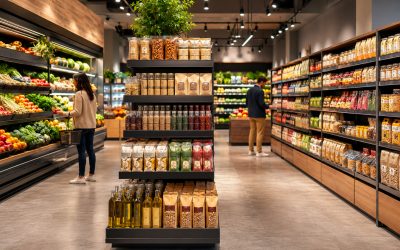
In recent years, the food sector has undergone a profound transformation in distribution and sales methods. The growth of e-commerce, accelerated by the digitalization of consumption and evolving purchasing habits, is changing the way food producers reach the end consumer.
At the same time, large-scale retail trade (GDO) continues to represent one of the main sales channels for the food and beverage sector, thanks to its territorial coverage and ability to intercept large volumes of demand.
What until a few years ago was perceived as a potential conflict between online sales and traditional distribution is now transforming into an opportunity for strategic integration. More and more companies are realizing that e-commerce and large-scale retail can coexist and mutually strengthen each other, generating new opportunities for commercial growth and brand positioning.
For food manufacturers, the real challenge is not choosing between one channel and another, but building a coherent and complementary multichannel strategy.
The evolution of purchasing behaviors in the food sector
Today’s consumer is increasingly accustomed to switching between different purchasing channels. There is no longer a clear distinction between online and offline: customers can discover a product online, purchase it in a supermarket, or have it delivered directly to their home via a digital platform.
This phenomenon is particularly evident in the food sector. While daily shopping remains strongly tied to physical stores, there is growing interest in digital solutions that allow people to purchase products directly from producers, access local specialties that are difficult to find in large-scale retail outlets, have fresh or packaged products delivered directly to their homes, and compare prices, features, and reviews.
This evolution in purchasing behavior is pushing many food manufacturers to consider e-commerce not just as an alternative channel, but as a strategic communication, branding, and sales tool.
The central role of large-scale retail trade in food distribution
Despite the growth of e-commerce, large-scale retail trade continues to be the primary distribution channel for most food products. Supermarkets, hypermarkets, and retail chains guarantee widespread visibility across the country and allow producers to reach millions of consumers.
Presence in large-scale retail trade offers numerous advantages, including high sales volumes, brand visibility on shelves, access to promotional campaigns, and greater product credibility in the eyes of consumers.
For many producers, particularly in the wine and food sector, entering the large-scale retail trade still represents one of the main objectives of their commercial strategy.
However, competition on the shelves is very intense. To stand out, you need to develop a clear positioning, an effective marketing strategy, and carefully manage category management dynamics.
E-commerce and large-scale retail trade: from competition to integration
In the past, some manufacturers feared that online sales could create conflicts with traditional distribution. Today, this view is rapidly changing.
More and more companies are understanding that e-commerce and large-scale retail trade play different but complementary roles within their commercial strategy.
E-commerce allows you to tell the brand and product story, communicate directly with the end consumer, test new products, collect data on purchasing behavior, and develop direct customer relationships.
Large-scale retail trade, on the other hand, continues to guarantee volume, territorial distribution, and access to the general public.
When the two channels are managed in coordination, they can reinforce each other. A product discovered online can be purchased in the supermarket, while its on-shelf presence increases brand awareness and also stimulates digital sales.
New opportunities for food producers
The integration between e-commerce and large-scale retail trade opens up particularly interesting opportunities for food producers, especially those looking to enhance the quality of their products and build a more direct relationship with consumers.
Among the most significant opportunities, some fundamental strategic dynamics emerge.
Brand strengthening
E-commerce allows producers to share their business ventures, their region of origin, and the distinctive characteristics of their products. This type of narrative is difficult to develop on the shelves of large-scale retail outlets, where communication space is limited.
An e-commerce site or a presence on specialized marketplaces allows you to build a deeper relationship with the customer, increasing the perceived value of the brand.
Direct access to the consumer
Online sales allow you to establish a direct relationship with the end consumer, gathering valuable information on preferences, habits, and purchasing behaviors.
This data also represents a strategic resource in relationships with large-scale retail trade, allowing producers to present more targeted and data-based commercial proposals.
Testing new products
E-commerce is an ideal environment for testing new items, limited editions, or innovative products before offering them to large-scale retailers.
This approach reduces launch risks and allows you to gather direct feedback from consumers.
International expansion
Another advantage of e-commerce is the ability to reach foreign markets without the need to immediately build a physical distribution network.
For many Italian food companies, especially in the wine and specialty food sectors, online sales represent a gateway to international markets and an effective tool for promoting Made in Italy products.
Strategies to effectively integrate channels
To fully exploit the opportunities offered by the integration between e-commerce and large-scale retail trade, it is necessary to develop a clear and coherent strategy.
A key aspect concerns the management of prices and commercial policies, to avoid conflicts between the different channels.
It is also essential to maintain consistent communication across all touchpoints: website, social media, marketplace, and physical stores.
Logistics and organizational management must be structured to effectively support both traditional distribution and online sales.
Finally, it’s important to adopt a long-term vision: the goal isn’t simply to launch an e-commerce site, but to build an integrated commercial ecosystem capable of enhancing the product and strengthening its market presence.
The future of food distribution
The food and beverage sector will continue to evolve in the coming years driven by digitalization and changes in consumer behavior.
Food manufacturers that intelligently integrate traditional distribution and digital channels will have greater opportunities to strengthen their competitive positioning.
E-commerce will not replace large-scale retail trade, but will increasingly become a complementary tool for building direct relationships with consumers and developing new market opportunities.
For manufacturers, the real opportunity lies in turning multichannel into a strategic advantage, creating synergies between online and offline capable of generating sustainable growth over time.